Emergency Collection
- Research Activities
- Cultural Heritage Conservation Science Center
- 현재 위치Emergency Collection
Long-buried relics become corroded to such an extent that they cannot support their weight. Thus, before unearthing and collecting them, rapid environmental changes should be minimized, and scientific emergency-collection methods should be used to prevent separate pieces from being mixed during carriage so as to maintain their original forms.
Important factors in determining which method of relic collection should be used include the relic’s status, size and location.
Relics obtained from prehistoric sites are mostly unearthed from the soft soil layers, thus widening the choice of collection materials, whereas the unearthing of relics from ancient tombs is limited by the tombs’ narrow confines, and whereas these relics remain in the mounds of stones, thus limiting the choice of collection materials. Furthermore, complex relics composed of diverse materials are often unearthed from building sites and stone pagodas' Sarira reliquaries, thereby requiring the reinforcement of the area or the use of the appropriate implements to collect them.
Before collecting important relics, advice should be sought from highly-experienced experts, literature on the relevant relic collection skills should be referred to, and a collection plan should be drawn up along with the selection and preparation of the relevant equipment. Prior measures should be thoroughly prepared against possible accidents, and collection should ideally be carried out in a day, if possible. Also, before collecting the relics, they should be recorded in detail, photographed, and copied, and any possible obstacles should be removed.
Emergency Collection Process
1. Documentation
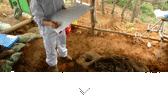
The work of documenting a relic’s status, location and specifications before emergency collection.
2. Separation of supplementary remains and materials adjacent to the relic
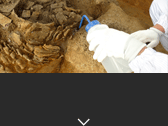
A relic should be separated from being fixed onto the corroded supplementary materials and metals in the remains before conducting an emergency collection thereof. Chelating agents (Oxalic acids, citric acids, EDTA, etc.) and aqueous solutions should be used to soften metal corrosion.
3. Dehydration
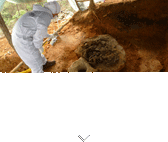
Relics are coated with reversible synthetic resins to prevent them from being damaged during collection. Relics should be uniformly penetrated and coated with such resins. However, if the moisture content of the unearthing opening is high, it will jeopardize the chemicals' reinforcing function, so the moisture contained in the soil layers should be evaporated with ethanolor, methanol, etc.
4. 1st surface protection
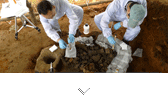
To protect a relic’s exposed surface from external shocks, Paraloid B72 and gauze are used.
5. 2nd surface protection

As with the first protection measure, to protect a relic’s exposed surface from external physical shocks, plaster bandage and urethane bondage are used.
6. 3rd surface protection

The vertical surface of a soil layer in which a relic is buried receives internal and external physical pressure when it is moved, so its surface should be protected again using urethane bondage.
7. Packaging
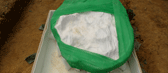
A collected relic should be put in a carriage box with its empty spaces filled with fillers such as urethane foam before carrying it to the conservation laboratory.