Conservation of Excavated Relics
- Research Activities
- Gyeongju National Research Institute of Cultural Heritage
- 현재 위치Conservation of Excavated Relics
From around 1973, concerns regarding the conservation of relics unearthed during large-scale excavation research in the Gyeongju area, including those discovered at specific sites such as Cheonmachong Tomb, Hwangnamdaechong Tomb, Anapji Pond, and Hwangnyongsa Temple Site, increased considerably, leading to the establishment of a “conservation room” at the Gyeongju Historical Remains Excavation Research Group in 1982. This facility was designed to provide the relics excavated at each site with immediate and effective protection.
Since 1990, the year in which the Gyeongju National Research Institute of Cultural Heritage was established, conservation efforts have broadened to include not only the conservation of excavated relics, but also material analysis, microstructure examination, dating, and the investigation of phenomena related to major stone-made cultural assets. Notably, coinciding with the relocation to the Excavated Relic Conservation Hall, cutting-edge technological equipment such as an X-Ray Fluorescence Spectroscopy (XRF) machine and a scanning electron microscope (SEM-EDX) were introduced in order to raise the standards of scientific research and provide preliminary data to assist the investigation of manufacturing processes of ancient relics, and to determine the istoryof art materials.
Scientific Preservation of Heritage
Metal Artifacts
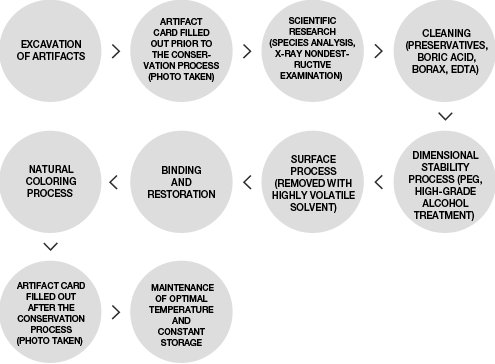
1. ARTIFACT COLLECTION AND CONDITION SURVEY
To preserve the relics unearthed from the excavation research sites, a polyurethane type of resin was used to transfer them safely to the conservation room; furthermore, before and after pictures were taken of the excavated relics and record cards from the actual survey were filled out accordingly.
2. SCIENTIFIC RESEARCH
Through X-Ray and microscopy investigations, the composition, production techniques (Pattern, production process, and characteristics via analysis of the quality of the material and microstructure), level of corrosion, and surface organic material and corrosion product deposits of the relics were assessed.
3. MECHANICAL (PHYSICOCHEMICAL) HANDLING OF CORROSIVE CHEMICALS
Corrosive materials were chemically removed using physical and mechanical methods as well as chemicals, i.e., a precision spray machine (Using the pressure of Glass Powder (No9) and N2 Gas), an ultrasonic wave drill, an ultrasonic cleaner, and various small medical devices.
4. DESALINATION AND STABILIZATION PROCESS
Desalination and stabilization processes include the extraction of corrosive factors through the use of chemicals (Na2CO3, NaOH, LiOH, etc.) and stabilization to prevent re-corrosion of the relics by impregnating them with unsaturated corrosion restrainers (BTA, DAN, etc.).
5. HARDENING BY QUENCHING AND BINDING/RESTORATION
Vacuum decompression and surface-hardening by synthetic resins (Acryl type, Epoxy type, etc.); binding and restoring of damaged and missing sections using instant glue, Cemedine-C, Araldite rapid type, which is an epoxy adhesive; color-matching using natural paint.
Preservation of Metal Artifacts
Treatment Status of Gilt Bronze Artifacts
Gilt-bronze Plate Buddha found at the Hwangnyongsa Temple excavation site.
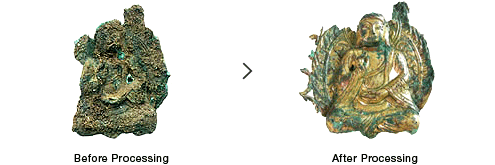
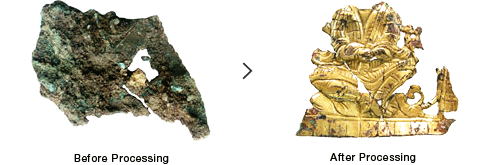
Gilt-bronze Plate Buddha found at the Hwangnyongsa Temple excavation site.
.gif)
Treatment Status of the Bronze Artifacts
Bronze head of Buddha found at the Hwangnyongsa Temple excavation site.
.gif)
Bronze ornament found at the Hwangnyongsa Temple excavation site.
.gif)
Bronze mirror found at the Bunhwangsa Temple excavation site.
.gif)
Treatment Status of Iron Artifacts
Forging tools found at the Wolsanni Relics excavation site in Gyeongju.
.gif)
Jeonggongcheong Helmet, the 38th Important Folklore Material of Gyeongju.
Wooden Artifacts
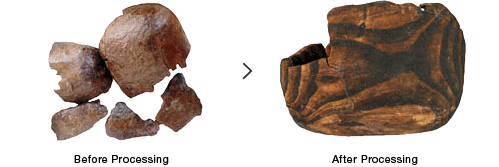
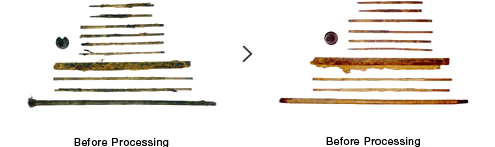
Since wooden artifacts are prone to rapid contraction and contortion due the evaporation of moisture that occurs immediately upon completion of excavation work, they are immediately subjected to a dimensional stabilization process and species analysis, thereby preserving the artifact while simultaneously collecting data.
Preservation of Wooden Artifacts
Durebak (well bucket) of Seobudong Excavation site in Gyeongju
Jeonggongcheong Arrow Shaft, 38th Important Folklore Material of Gyeongju
Pottery and Earthenware ArtifactsWooden Artifacts
The most common artifacts to be found at excavation sites are those made from pottery and earthenware, which can be preserved for a considerable period of time as long as they are not subjected to any external impact. They can be restored by basic conservation processes and for this particular reason are comparatively neglected. Pottery and earthenware are often damaged by pressure once they are underground, while after excavation, most damage is caused by careless handing. Furthermore, during the conservation process, they are subject to damage due to incorrect treatment methods or material selection, or during the surface cleaning process.
Pottery and Earthenware Artifacts
Conservation process of the roof tiles excavated at Inyongsa Temple Site
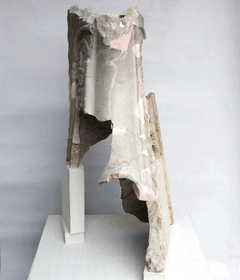
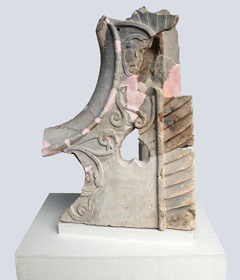
A total of twenty roof tiles were excavated from Inyongsa Temple Site. During the initial pre-binding process, it was discovered that certain sections of the tiles, i.e., on the underside, half of the lower left side, the upper part of the tail, and the connecting section of the back, were missing. The restoration process was carried out using a roof tile restoration method consisting of cleaning, mock binding, binding reinforcement, restoration and color-matching.
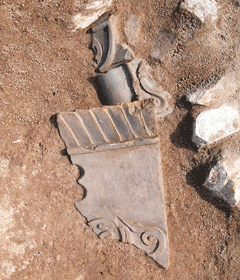
Condition at excavation
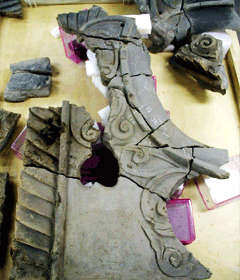
Mock-binding
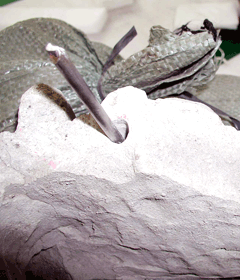
Stainless steel reinforcement
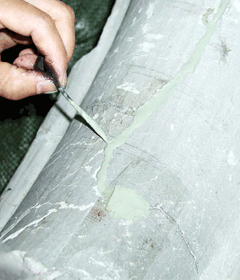
Cleaning of the tile’s surface
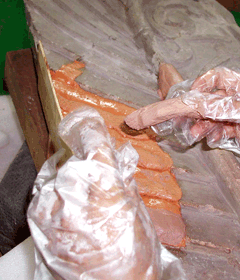
Restoration of CDK-520
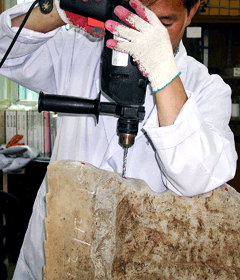
Cleaning of the tile’s surface
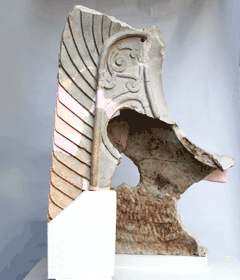
After treatment, Left side
After treatment, Front
After treatment, Right side
Stone Cultural Assets
Stone cultural assets, which are mostly made of granite, consist of pagodas, statues of Buddha, tombstones, round stone towers, flag pillars, cisterns and bridges. As most of the stone cultural assets are located outdoors and have experienced natural weathering as a result of their exposure to rain and wind over sustained periods of time, accelerated by environmental pollution, conservation measures are urgently required.Due to the robust nature of stone assets, conservation of other, more delicate materials has been prioritized; however, with the recent illumination of the importance of stone cultural assets, research studies are actively under way.
Preservation of Stone Cultural Assets
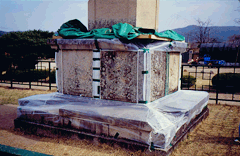
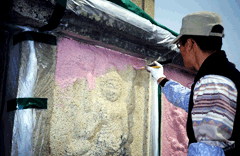
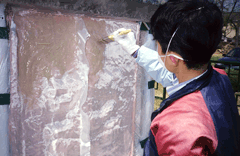
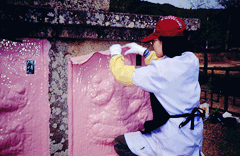
Preservation process of the Seoang-ri Three-story Stone Pagoda in Gyeongju
For research on the condition, assessment of damage caused by weathering, and the preservation treatment process for the Seoang-ri Three-story Stone Pagoda in Gyeongju, National Treasure, the following steps were taken.
Preservation treatment process
Maintenance of the surrounding environment
- Installation of a drainage ditch, minimization of rain water runoff, removal of trees and grass in the immediate area, control and prevention of lichen and moss growth.
Cleaning
- Initial dry cleaning executed – soft brushes and wooden spatulas were used.
- Second wet cleaning executed – high-temperature steam was used.
- Synthetic resin (L-30) was used to bind and reinforce; talc and alkali granite power were mixed and used as filler; concrete and epoxy resin used during previous conservation efforts were removed.
- Color-matching - color was added in the process of mixing synthetic resin and filler.
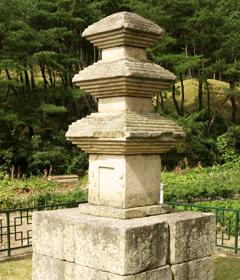
Before the treatment
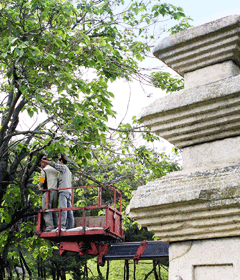
Trees removed
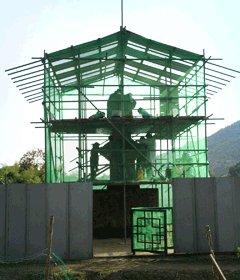
Scaffolding erected
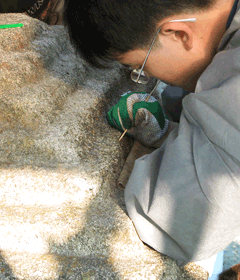
Dry cleaning 1
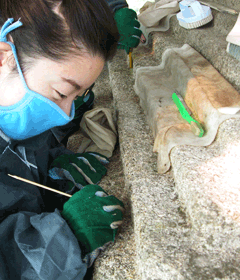
Dry cleaning 2
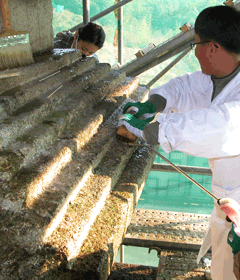
Wet cleaning 1
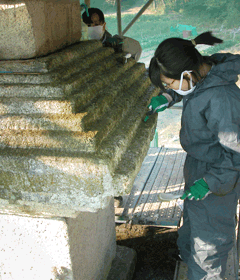
Wet cleaning 2
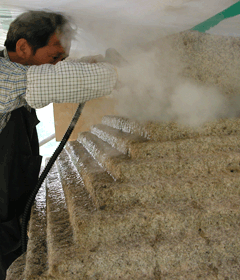
Steam cleaning
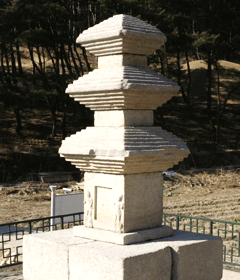
After the treatment
Scientific Study and Research of Cultural Assets
The excavated relics connote the changing aspects of the society, economy, and culture of the period in which they were made. Through scientific methods, academic information regarding production techniques based on time period, locality, and material as well as information on the relics’ absolute age can be obtained.
Scientific Study and Research of Cultural Assets
Material analysis
The composition and properties of each artifact can be ascertained through the use of Atomic Absorption Spectroscopy (AAS) and X-ray Fluorescence Spectroscopy (XRF).
Measurement of absolute age
The absolute date of an artifact can be ascertained by using carbon and thermo-luminescence dating methods, and the credibility of the recorded chronology can be enhanced by conducting a comparative analysis with other relics from the same period.
Microstructure examination
A Scanning Electron Microscope (SEM) and metal optical microscope are used to examine the microstructure of the artifacts, and thus to investigate the processes employed in their manufacturing and engineering, etc., including casting, forging, carbon content, and carbon distribution.
Microstructure examination
A Scanning Electron Microscope (SEM) and metal optical microscope are used to examine the microstructure of the artifacts, and thus to investigate the processes employed in their manufacturing and engineering, etc., including casting, forging, carbon content, and carbon distribution.
Species identification
Analysis through microtome, biological microscope, and precision video microscope.
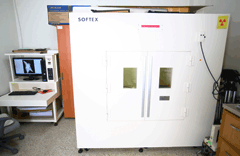
X-ray (SOFTEX PROTEST-150. JAPAN)
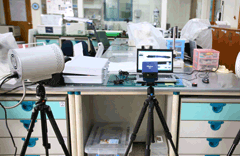
Infrared movie camera
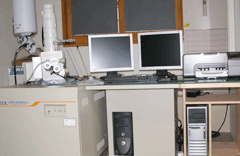
Scanning electron microscope
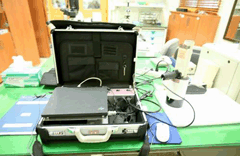
XRF: X-Ray Fluorescence Spectroscopy
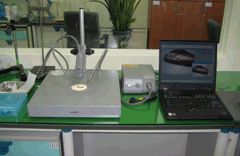
Video Microscope
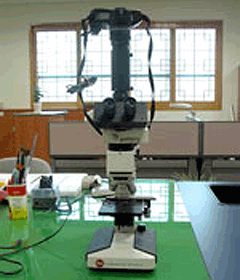
Metallographic microscope
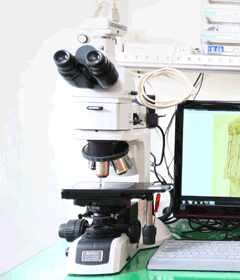
Biological microscope
Soil Stratum Copy of the Cultural Asset and Replica Production
As excavated relics are exposed to the open environment, external impacts, changes in temperature /moisture, rises in the ground water, and the dissemination of microscopic organisms due to seasonal changes, identical copies must be made and moved to or restored at a different location in order to preserve the original relics.
Soil Stratum Copy
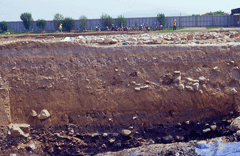
Soil Stratum Condition
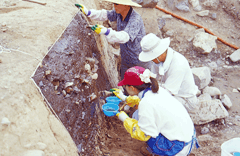
Resin application for the copy
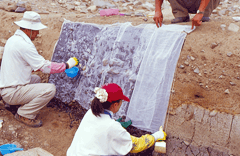
After attaching gauze Reapplication of resin to the copy
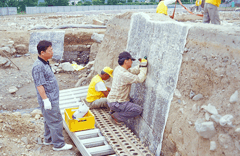
Copied Soil Stratum division
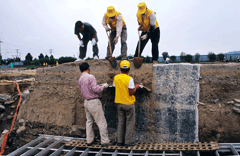
Copied Soil Stratum incision
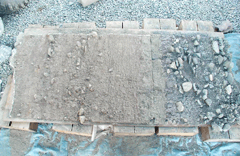
Metallographic microscope
Soil Stratum Copy Production Process
- Cleaning up of the relevant surface of the relic
- (Apply P.V.Ac 5% solution to vulnerable parts)
- Hardening by applying P.V.Ac 20% solution and P.V.Ac 10% solution once each
- Attaching of gauze and application of P.V.Ac solution again Divide and dry of the soil stratum copy

- Application of DFR 108 · DFH 108(1:1) to the surface of the soil stratum
- Attachment of fiberglass and application of resin again
- Application of P.V.Ac and gauze to the surface of the copy using methyl alcohol or ethyl acetate
- Sealing with vinyl for 2-3 hours
- Separating gauze from the soil stratum
- Hardening of the surface of the relic with P.V.Ac 5% solution
- Application of DFR 108 · DFH 108(1:1) to the surface of the soil stratum
- Attachment of fiberglass and application of resin again
- (Repetition of the above steps twice)
- Restoration by placing and gluing fragments back to the original spot Securing inclined and uneven planes with screw spikes
- Upon completion of adhesion, removing the screw spikes and filling with epoxy resin
- Strengthening the join between the severed pieces with epoxy resin and fiberglass
- Finishing the surface with the same type of clay
- Application of 7~8% PSNY6, a hardening agent, to the surface of the restored relic twice
- Confirmation that the surface color is same as the color when first excavated
Model Production
Pre-treatment of the model mold
Application of silicon
F.R.P, resin treatment
Removal of model mold
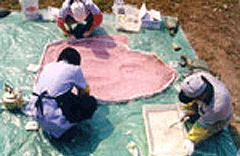
Division of boundaries
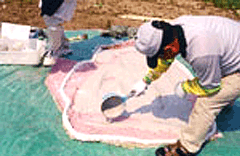
Filling of cast
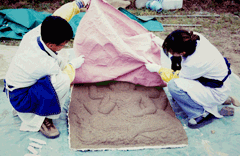
Separation of racks
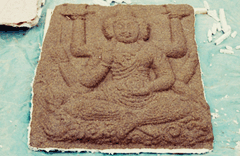
Completion of model
Soil Stratum Copy Production Process

- Artifact condition and site field investigation
- Selection of model frame material and estimation of quantity required

- Installation of the work notification sign and protective shield
- Removal of foreign substances (Soil, dirt, etc.) from the surface of the artifact
- Cracks and pores – prevention of the penetration of mold material by filling with paper and clay
- Implementation of safety measures to prevent contamination of other parts
- Combining the main ingredient of silicon with hardening agent – spreading evenly on the surface of said artifact
- After hardening, resurfacing with silicon – placing gauze (Repeat 4-5 times)
- Polyester resin + talc + hardening agent – application to the interior part of the form-board
- Right before hardening, reinforcement by adding fiberglass
- (Repeat 4-5 times)

- Once the hardening process is completed, separation from the form-board
- write artifact’s name and location

- After selecting the appropriate forming material (Epoxy resin, POR-ROK, etc.), injecting the forming material into the model form-board and then remove

- Adding to the bubbled area, finishing with matching natural paint
Support for the Conservation of Cultural Assets and Consultation Activities
Our research institute also provides support for the conservation of important cultural assets and assistance in the Gyeongju (Silla) area, and has assumed the role of a consultant; furthermore, we have channeled considerable effort into educating specialists through practical training and lectures.