News
- 현재 위치News
Discover Lightweight Hanji for Cultural Heritage Conservation Through Physical Samples and Scientific Data
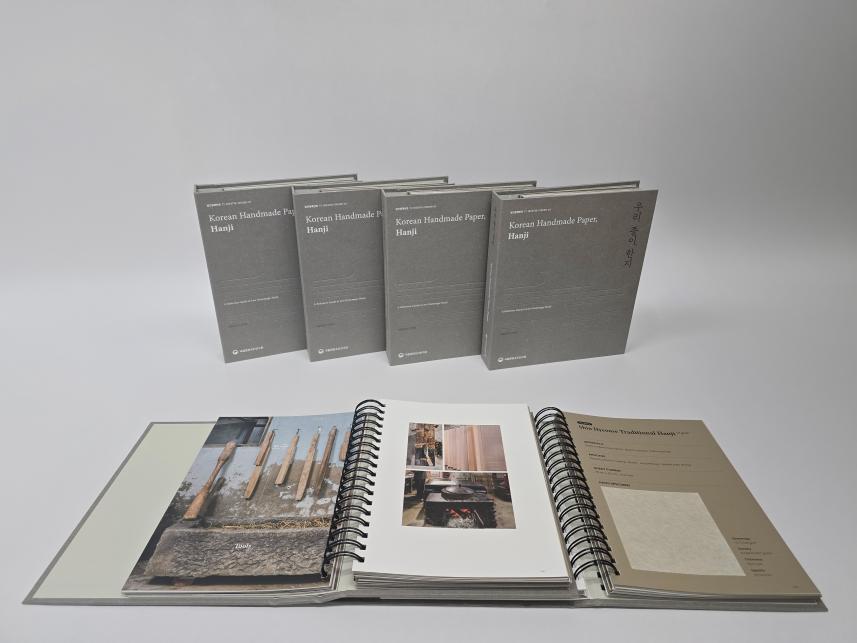
The National Research Institute of Cultural Heritage (NRICH), under the Korea Heritage Service (KHS), has published Our Paper, Hanji: A Reference Guide to Lightweight Hanji to systematically document the characteristics of lightweight Hanji suitable for cultural heritage conservation and restoration and to help conservation professionals select appropriate restoration materials.
Note: Basis weight refers to the weight of paper per unit area, expressed in grams per square meter (g/m²). For the purposes of this publication, lightweight Hanji is defined as thin, lightweight Hanji with a basis weight of less than 15 g/m² to facilitate the presentation of the research findings.
The publication features physical specimens of lightweight Hanji suitable for cultural heritage conservation treatments, produced by six master artisans recognized as holders of National or City/Provincial Intangible Cultural Heritage designations for Hanjijang (traditional Hanji craftsmanship). It also presents measurements of fundamental physical properties and the results of material characterization. Together, the specimens and scientific analysis data allow readers to examine and compare variations in the characteristics of lightweight Hanji depending on the papermaker and production environment.
Hanji has long been an essential traditional material in cultural heritage conservation and restoration. Its production reflects the accumulated experience and expertise of artisans who have preserved Korea's traditional papermaking techniques across generations. Because its characteristics vary depending on the individual papermaker and production environment, objectively assessing its physical properties and systematically compiling the resulting data provide an important foundation for both the transmission of traditional papermaking techniques and the appropriate use of Hanji in restoration work.
Hanji has already demonstrated its potential through its use in major cultural heritage restoration projects across Europe. In 2016, Italy's Central Institute for the Conservation and Restoration of Archival and Library Heritage (ICRCPAL, now ICPAL), a specialized institution for cultural heritage conservation and restoration, recognized two types of traditional Hanji produced by Shin Hyeon-se, a nationally designated holder of Hanjijang craftsmanship, as suitable materials for cultural heritage restoration. Hanji has since been used in the restoration of Italian cultural heritage objects, including the Chartula, a prayer written by St. Francis of Assisi in 1224. It has also been used to restore 18 eighteenth-century portraits associated with the French royal family at the Louvre Museum in France and eight globes cherished by Pope John XXIII at the Vatican.
Meanwhile, South Korea is awaiting a decision on the inscription of Traditional Knowledge, Skills and Cultural Practices of Hanji Making on UNESCO's Representative List of the Intangible Cultural Heritage of Humanity. The decision is expected to be made at the 21st session of the Intergovernmental Committee for the Safeguarding of the Intangible Cultural Heritage, scheduled to take place in Xiamen, China, from November 30 to December 5. If inscribed, the tradition is expected to gain greater international recognition not only for its exceptional papermaking techniques but also for the traditional knowledge and cultural values that artisans and local communities have sustained together over generations. Inscription is also expected to help expand the use of Hanji in cultural heritage conservation and restoration worldwide.
The full publication is also available on the Korea Heritage Knowledge Portal (https://portal.nrich.go.kr), where it is freely accessible to the public.
NRICH will continue to systematically document traditional papermaking techniques and build a body of scientific knowledge about them to raise awareness of Hanji's exceptional qualities and cultural value both in Korea and abroad. Through international cooperation and the sharing of research findings, NRICH also aims to expand opportunities for the use of traditional Hanji in cultural heritage conservation and restoration worldwide.